Ask these six “consumer questions” when vetting a story:
Who made this?
How was this made?
Why was this made?
When was this made?
What is this missing?
Where do I go from here?
"Backtrack Journal" --Choose a video you have watched and shared (this should take no longer than five minutes--don't get distracted and carried away watching a ton of You Tube videos). Ask the "consumer questions" above. Create a "backtrack journal" (using Google Slides--go to Google Classroom for template) showing when and where the video, post or article first appeared.
We are going to read Harriet Tubman: Guide to Freedom a story
that describes the Underground Railroad and Harriet Tubman's role in
helping free the slaves in the south in the 1800s. Before we read the
story in our textbook, you are going to learn a little about The
Underground Railroad and Harriet Tubman by watching a video, completing a
web quest and completing an interactive journey on The Underground
Railroad yourself.
Your assignment is to complete the web quest on Harriet Tubman. Follow the directions on the sheet and learn more about Harriet Tubman. There is a copy of the webquest questions posted on Google Classroom.
Further Reading- Click here to go to our Follet Book Shelf in Library Resources on the Barnard Webpage -you will need to log in- username: guest password: barnard
From the virtual bookshelf choose either Go Free or Die or How Did Slaves Find a Route? and read more about Harriet Tubman and the Underground Railroad. Then show what you know. Add three tags to the Harriet Tubman Thinglink.
login-scasassa@sau21.org
password-barnardla
1. Image with a caption
2. Link to a website/video that adds to our knowledge of the topic
3. Fact or detail that tells more about the image you put your tag on
We will be analyzing both the poem "Nothing Gold Can Stay" by Robert Frost and the scene in The Outsiders where the Ponyboy recites the poem. Now we will watch the video clip from the movie to analyze the mood and tone. How are they the same? How do they differ? How does the camera angle contribute to the mood in the film? How does the author's style contribute to the mood? What are the emotions the director wanted the audience to feel? What emotions did the author want to evoke in the reader?
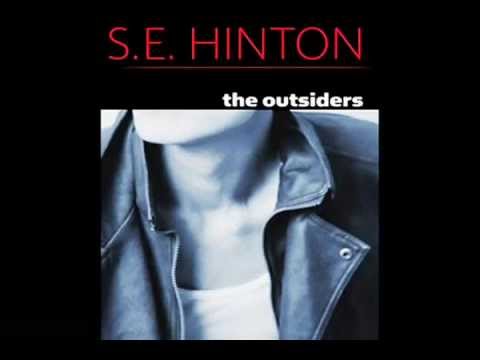
The Outsiders by S. E. Hinton- We will be reading some of the book as a class and some independently. You may listen to the audio version of the novel but please also follow along with your book--eyes on the page!
CHAPTER 1
Step 1: Read Chapter 1 of The Outsiders
You
may read this chapter silently to yourself or follow along in your book
while you listen to the audio. Either way, eyes must be on print.
Step 2: Choose a character to track their character traits as you read. Mark places in Chapter 1 that you see specific character traits.
Step 3: In your Reader's Notebook-in the Writing about Reading Section, begin a T-chart comparing the greasers and socs. Be sure to include page numbers and specific examples from the text.
CHAPTER 2
Step 1: Read Chapter 2 of The Outsiders
Now that you have finished chapter 1, go ahead and read chapter 2.
Step 2: Continue tracking your character. Create a page in your Reader's Notebook that shows your thinking about this character. Include character traits, specific examples and page #s where possible. (this is like the work we did with Will in the story"Popularity")
Step 3: In your Reader's Notebook-in the Writing about Reading Section, continue to fill in the T-chart comparing the greasers and socs. Be sure to include page numbers and specific examples from the text.
60s Throwbacks
Music-The Beach Boys, The Beatles
Interested in learning more about S.E. Hinton? Check out the link below.
After the Holocaust, the United Nations created laws to prevent such an atrocity from ever happening again. The Convention on the Prevention and Punishment of the Crime of Genocide was held in 1948 and declared that genocide was a crime under international law and would be condemned by the civilized world. Since that time, however, there have been other acts of genocide. For your final project, you will familiarize yourself with other modern day acts of genocide.
Assignment: You will create a brief video educating people about the dangers of genocide, informing them about modern day examples of genocide and calling them to action.
Possible Genocide to research: Armenian Genocide Rwanda Genocide Darfur Genocide in Bosnia and Herzegovina The Killing Fields: The Cambodian Genocide
Consider these questions: What can we do to prevent further acts of hatred and violence towards a race of people? Why do these acts continue to happen despite our knowledge and education? How can you make a difference?
Use the resources below to learn about the modern day examples of genocide.
We are going to begin a unit on Greek and Roman Mythology. Before we
start consider the question of what is a myth? Why do people and
cultures tell stories? How do the gods a culture worship tell us what
that culture values and thinks is important? Finally, where do we see
these ancient myths and gods in our world today? Ever heard of a brand
called Nike? Hermes? Atlas? To start, let's watch this brief overview.
Myths are a way of understanding the world. This
lesson has been about Greek mythology, but every culture has myths.
Myths define social customs and beliefs, explain natural and
psychological phenomena, and provide a way for people to discuss things
that cause anxiety. Mythology is all around us.
Here are just a few examples of places we find myths today.
Days of the week Wednesday (Woden or Odin – Norse god);
Thursday (Thor – Norse god); Friday (Freya Norse goddess); Saturday
(Saturn – Roman god who ruled before Jove)
Shoes Nike
Cars-Toyota Avalon and Cressida, Cadillac El Dorado, Honda Odyssey, Mercury
Tires Midas
Astronomy Constellations like Orion, the Argo, all of the
planets and the Pleiades. The Milky Way itself was supposedly the road
over which the stars traveled to Jupiter’s palace.
NASA The first part of U.S. space program was Project
Mercury, named after the messenger of the gods because the project’s
purpose was to send a message to the Soviets that America was in the
space race. The Gemini Project was next; Gemini is Latin for “twins,”
and the project was called this because the capsule held two astronauts.
Apollo astronauts rode on Saturn rockets.
Myths also make great stories. They come up in literature all
over the place, from really serious stuff like Dante to comic strips.
Myths inspire music; actually the word music comes from the mythological
muses who inspired art of all kinds. Painters such as Michelangelo and
Botticelli were inspired by myths. Even children’s movies are a good
place to look for myths; you will find them everywhere, including Snow
White, Star Wars and The Lord of the Rings.
(Taken from
http://www.mensaforkids.org/MFK2/assets/File/Teach/LessonPlans/Lesson_GreekMythology.pdf)