Common Craft
videos are made using simple paper cutouts and dialogue that focuses on
explaining concepts "in plain English." Pioneered by Lee and Sachi
LeFever, this style of video utilizes a white background and will have
all elements planned out to make a complex subject simple. Another key
to the video style is that it is short, usually around two to four
minutes (definition from edutopia).
For the first tech project of the year, you are going to create Common Craft-like videos to explain the new concepts and ideas you are learning about The Economy in Social Studies class. Before you begin, however, you need to understand what a Common Craft video is like. Watch the examples below.
Please, no Zombies in your videos! So...where to begin?
1. Decide on an idea--get it approved by a teacher!
2. Create a script--keep it simple and clear!
3. Create visuals--Keep them simple and eye catchingly BOLD! This is not the assignment for fancy details. -click here to access the cut-outs from the Common Craft site
4. Practice! You want to be able to narrate your script smoothly without mistakes. You also need to know when to change your props! The actual video taping should not take more than 10 minutes!
5. Film your Common Craft-like video
6. Show the class---and the world. Help people understand how and why the econmoy works!
7. Have fun!
More resources:
Making Common Craft Style videos: Here's a How-to that gives some good tips for making these videos. You don't have to read everything. Just take a look at the diagrams.
Wednesday, September 23, 2015
Tuesday, September 22, 2015
Wednesday, September 9, 2015
Scope Magazine: "Why are Your Clothes So Cheap?"

This narrative nonfiction article reveals the shocking truth about the lives of those who make our clothing and provides important information about the global garment industry and child labor.
Click here to read this article.
Log-in: barnardla68

Essential Questions
1. What does it mean to be a global citizen?
2. How can individuals affect huge companies?
3. What is the power of working together?
Student Resources
Vocabulary from story
Close Reading Questions (we will discuss as class--no need to write out)
Nonfiction Elements worksheet
Guided Letter Writing

Tuesday, September 1, 2015
Collecting Quotes about Reading and Writing
In her book Bird by Bird: Some Instructions on Writing and Life, Anne Lamott says,
“For some of us, books are as important as almost anything else on earth. What a miracle it is that out of these small, flat, rigid squares of paper unfolds world after world after world, worlds that sing to you, comfort and quiet or excite you. Books help us understand who we are and how we are to behave. They show us what community and friendship mean; they show us how to live and die.”
“For some of us, books are as important as almost anything else on earth. What a miracle it is that out of these small, flat, rigid squares of paper unfolds world after world after world, worlds that sing to you, comfort and quiet or excite you. Books help us understand who we are and how we are to behave. They show us what community and friendship mean; they show us how to live and die.”
"Selecting a Reader" by Ted Kooser
"Selecting a Reader" by Ted Kooser
 After reading the poem, in the Response section of your R/W Notebook describe what the woman in the poem looks like. Underline the words that support your description.
Next, underline words or phrases that you noticed as we read the poem. Place a question mark next to any lines that you are confised by.
Why does the speaker choose this reader? What type of reader would you choose for your writing? Explain your answer.

Next, underline words or phrases that you noticed as we read the poem. Place a question mark next to any lines that you are confised by.
Why does the speaker choose this reader? What type of reader would you choose for your writing? Explain your answer.
Welcome Back!
Welcome Back! It was so nice to see all the middle school students today. Everyone found a book and spent some time reading this afternoon! I am looking forward to a wonderful year of reading and writing with all of you. Here's our new and improved classroom library!


Wednesday, July 8, 2015
Delaney Place--Eclectic excerpts every day from editor Richard Vague
Click here to read today's excerpt from Delaney's Place.
Here's today's excerpt:
Here's today's excerpt:
gershwin, rodgers, porter, kern, and berlin -- 7/08/15
Today's selection -- from The B Side by Ben Yagoda. In the 1920s, 1930s, and beyond, the America music scene was dominated by five composers -- George Gershwin ("Someone to Watch Over Me"), Cole Porter ("I've Got You Under My Skin"), Richard Rodgers ("My Funny Valentine"), Irving Berlin ("White Christmas"), and Jerome Kern ("All the Things You Are"). The work of these five giants still pervades American music today:
Wednesday, June 17, 2015
Tuesday, June 16, 2015
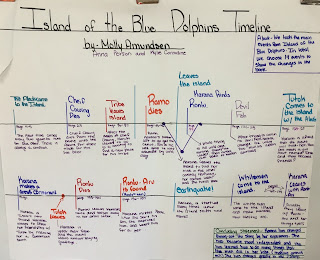
The Island of the Blue Dolphins
The 6th graders just finished reading The Island of Blue Dolphins by Scott O'Dell. After they created timelines of the significant events in the story. View the timelines below.




Monday, June 15, 2015
Jeopardy Review
It's hard to believe that we are entering the final week of the
school year. This week as a review, you are going to create jeopardy
questions for a Jeopardy Review Game. First we'll brainstorm a list of
all the topics we covered this year, and then write questions in the
format of a jeopardy game.
Example:
Answer: Brian used this to create fire.
Questions: What is a hatchet?
Click here to go to the Jeopardy Lab
The 6th grade Template is barnardla (username & password)
Click here to play the 6th Grade Jeopardy Game
Click here to play the 7th Grade Jeopardy Game
Example of a Jeopardy game--

Example:
Answer: Brian used this to create fire.
Questions: What is a hatchet?
Click here to go to the Jeopardy Lab
The 6th grade Template is barnardla (username & password)
Click here to play the 6th Grade Jeopardy Game
Click here to play the 7th Grade Jeopardy Game
Example of a Jeopardy game--
Thursday, June 11, 2015
You will be choosing a Greek god to become an expert on. You will be
creating a Trading Card about your god. You will find information about your god at the sites listed below.

Greek Mythology Resources:
Here's your job:

Greek Mythology Resources:
Here's your job:
Create a Greek God Trading Card
1. Choose a god to
make a trading card.
2. Use the resources listed below to research your god. You need to be able to answer the questions
below. You may take notes or complete
the graphic organizer. (Click here to access the graphic organizer)
·
Where do you read or see your god? What myth?
·
Identify the following character traits: physical and personality
·
What is your god’s most important
thoughts? Feelings?
·
What is your god’s problem or challenge in the
myth?
·
What does your god want to happen by the end
of the story?
·
Does your god succeed?
·
What memorable thing does your god say?
·
What is one interesting or important action
made by your god?
·
How does your god get along with others?
·
Do you like your god? Why or why not?
·
Does your god remind you of anyone?
3. Find image of
your god. Save image to your desktop
4. Click here to go the Trading Card Creator and begin creating your Greek god Trading card. Be sure to complete all the sections!
5. Click Finish
editing when you are done. Then click
Finish. Save your Trading card so you
may access it later. If you need to
edit it be sure to save as draft!
6. When you are
done (be sure to proofread/edit), take a screen shot of your trading card to
upload onto your blog.
7. Create a new
blog post. Label it Greek God Trading
Card. Upload your image onto the
post. Publish!
8. Print out a copy
of your trading card to share with class.
9. Click here to view Greek God Trading Card Rubric
9. Click here to view Greek God Trading Card Rubric
Subscribe to:
Posts (Atom)